

Local SEO Guide for Small Businesses: How to Rank Higher, Get More Customers, and Grow in 2026
If you’re looking for a Local SEO Guide for Small Businesses, you’ve come to the right place.
Local SEO has become one of the most effective digital marketing strategies for attracting nearby customers who are actively searching for products or services. Whether you own a restaurant, dental clinic, law firm, HVAC company, salon, retail store, or any other local business, showing up in local search results can significantly increase phone calls, website visits, and sales.
At DigiRankPrime, we’ve been helping businesses improve their online visibility through SEO and digital marketing. One thing we’ve consistently seen is that many small businesses don’t struggle because they lack great products or services—they struggle because potential customers simply can’t find them online. A well-executed Local SEO strategy helps bridge that gap by putting your business in front of people who are actively searching for what you offer.
In this comprehensive guide, you’ll learn how Local SEO works, why it matters more than ever, and the practical steps you can take to improve your visibility on Google Search, Google Maps, and AI-powered search experiences.
What Is Local SEO?
Local SEO (Local Search Engine Optimization) is the process of optimizing your online presence so your business appears when people search for products or services in a specific geographic area.
For example:
- Best coffee shop near me
- Emergency plumber in Chicago
- SEO agency in New York
- Family dentist nearby
Google analyzes location signals to determine which businesses are the most relevant for each search.
Unlike traditional SEO, Local SEO focuses on helping nearby customers discover your business when they’re ready to make a purchase, schedule an appointment, or request a service.
Why Local SEO Matters for Small Businesses
Consumer behavior has changed dramatically. Instead of browsing business directories, people now search Google, Google Maps, or ask AI assistants for recommendations.
A strong Local SEO strategy can help your business:
- Appear in Google’s Local Pack
- Rank higher on Google Maps
- Increase website traffic
- Generate more phone calls
- Build trust through customer reviews
- Attract highly targeted local customers
- Improve visibility in AI-generated search results
According to the DigiRankPrime team, one of the biggest mistakes small businesses make is focusing exclusively on social media while overlooking Local SEO. Social media is excellent for building awareness, but local search often reaches people with much stronger buying intent because they’re actively looking for a business like yours.
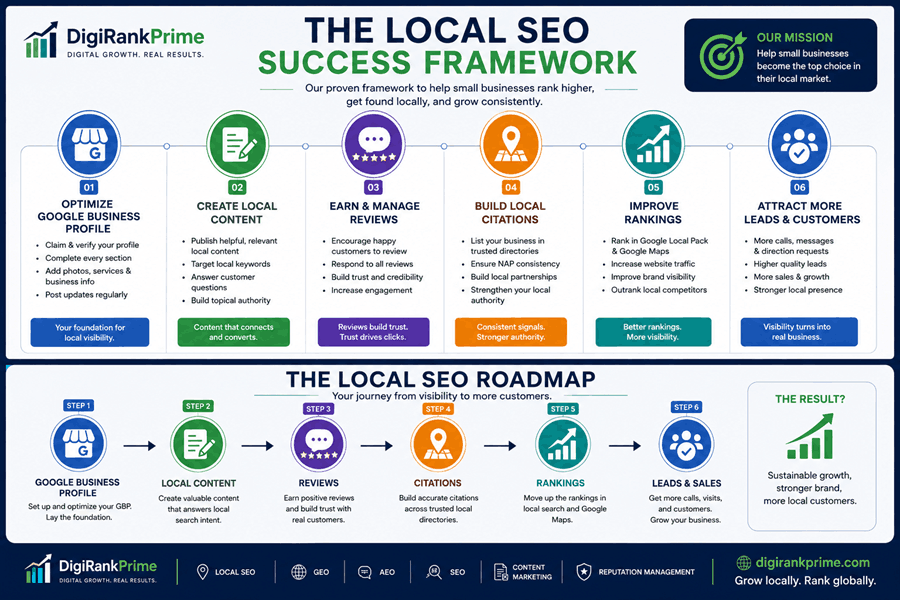
Step 1: Optimize Your Google Business Profile
Your Google Business Profile is one of the most important assets for Local SEO.
Make sure you:
- Use your exact business name
- Choose the most relevant primary category
- Add secondary categories where appropriate
- Write a detailed business description
- Upload high-quality photos
- Keep business hours updated
- Include your website and contact information
- List all your services
- Publish regular updates and offers
From our experience at DigiRankPrime, optimizing a Google Business Profile is often one of the quickest ways to improve local visibility. Even small updates—such as selecting the correct category, responding to reviews, and adding fresh photos—can increase customer engagement and improve local rankings over time.
Step 2: Keep Your Business Information Consistent
Consistency is essential.
Your business Name, Address, and Phone Number (NAP) should be identical across:
- Your website
- Google Business Profile
- Local directories
- Industry-specific listings
Search engines use this consistency to verify that your business information is accurate and trustworthy.
Step 3: Create Location-Focused Website Pages
If your business serves multiple cities or regions, create dedicated pages for each location.
For example:
- Local SEO Services in New York
- Local SEO Services in Dallas
- Local SEO Services in Miami
Each page should contain unique, helpful content tailored to that specific location. Avoid duplicating content across different city pages, as this can weaken your SEO performance.
Step 4: Research Local Keywords
Successful Local SEO starts with understanding what your customers are searching for.
Examples include:
- Local SEO agency near me
- SEO consultant in New York
- Best HVAC company in Chicago
- Roofing contractor in Dallas
Use tools such as Google Search Console, Semrush, Google Autocomplete, and People Also Ask to identify valuable local keywords with strong search intent.
Step 5: Create Helpful Local Content
Publishing valuable content helps both search engines and potential customers understand your expertise.
Ideas include:
- Local SEO Tips for Restaurants
- How to Optimize Your Google Business Profile
- Common Local SEO Mistakes
- How Customer Reviews Affect Local Rankings
- Local Marketing Strategies for Small Businesses
At DigiRankPrime, we’ve found that businesses publishing consistent, helpful content tend to build stronger authority over time. Instead of writing solely for search engines, focus on answering the real questions your customers ask every day. This approach not only supports traditional SEO but also improves your chances of being referenced by AI-powered search platforms.
Step 6: Earn Authentic Customer Reviews
Customer reviews play an important role in Local SEO.
Encourage satisfied customers to leave honest reviews on your Google Business Profile and respond professionally to every review you receive.
At DigiRankPrime, we encourage businesses to think beyond rankings. Reviews help establish credibility, increase customer confidence, and provide search engines with valuable trust signals that can improve long-term visibility.
Step 7: Build High-Quality Local Citations
Local citations are mentions of your business information across the web.
Examples include:
- Local business directories
- Chamber of Commerce websites
- Industry associations
- Local news publications
- Trusted business listings
Focus on quality rather than quantity. Accurate citations from reputable sources are far more valuable than hundreds of low-quality directory submissions.
Step 8: Optimize Your Website for Mobile Users
Most local searches happen on smartphones.
Make sure your website:
- Loads quickly
- Is mobile-friendly
- Includes click-to-call buttons
- Displays contact information clearly
- Provides simple navigation
A positive mobile experience improves both user satisfaction and search performance.
Step 9: Prepare for AI Search with GEO and AEO
Search is evolving beyond traditional search engine results.
Today, AI platforms such as Google AI Overviews, ChatGPT, Gemini, and other answer engines are helping users discover businesses and services.
To improve your visibility:
- Answer common customer questions
- Use descriptive headings
- Add FAQ sections
- Demonstrate expertise
- Keep information accurate and current
- Publish original, experience-based content
At DigiRankPrime, we’ve begun integrating Generative Engine Optimization (GEO) and Answer Engine Optimization (AEO) into our Local SEO strategies. We believe businesses should optimize not only for Google’s search results but also for the AI systems that are increasingly shaping how people find information online.
Common Local SEO Mistakes
Many small businesses unintentionally hurt their visibility by:
- Ignoring their Google Business Profile
- Using inconsistent contact information
- Publishing duplicate location pages
- Neglecting customer reviews
- Targeting overly broad keywords
- Having a slow or outdated website
- Creating content for algorithms instead of real people
Avoiding these common mistakes can significantly improve your long-term Local SEO performance.
Frequently Asked Questions Locan Seo
How long does Local SEO take?
Most businesses begin seeing measurable improvements within three to six months, although results depend on competition, website quality, and the consistency of your optimization efforts.
Is Local SEO worth it for small businesses?
Absolutely. Local SEO helps connect your business with nearby customers who are actively searching for your products or services, making it one of the highest-return digital marketing strategies available.
Do I need a physical storefront?
No. Service-area businesses can also benefit from Local SEO by properly configuring their Google Business Profile and targeting the geographic areas they serve.
Can Local SEO improve visibility in AI-powered search?
Yes. Creating helpful, trustworthy, and well-structured content increases the likelihood that AI-powered search systems will reference or recommend your business when answering user questions.
Final Thoughts
Local SEO isn’t about chasing algorithms—it’s about making it easier for customers to discover and trust your business.
At DigiRankPrime, we believe successful Local SEO combines technical optimization, valuable content, customer trust, and a commitment to delivering an outstanding user experience. As search continues to evolve with AI, businesses that invest in strong Local SEO today will be better positioned to succeed in both traditional search engines and next-generation AI search platforms.
Whether you’re just starting your Local SEO journey or looking to strengthen your existing strategy, consistent optimization can help your business attract more qualified local customers, build lasting authority, and achieve sustainable long-term growth.
Traditional SEO vs Local SEO vs GEO
| Feature | Traditional SEO | Local SEO | GEO (Generative Engine Optimization) |
|---|---|---|---|
| Primary Goal | Rank in organic search results | Rank in local search and Google Maps | Become a trusted source for AI-generated answers |
| Audience | National or global users | Nearby customers | Users asking AI assistants |
| Main Platforms | Google Search, Bing | Google Search, Google Maps | ChatGPT, Google AI Overviews, Gemini, Perplexity and other AI platforms |
| Keyword Focus | Broad and industry keywords | Location-based keywords | Questions, entities, expertise and topical authority |
| Key Ranking Factors | Content, backlinks, technical SEO | Google Business Profile, reviews, citations, proximity | Expertise, trustworthiness, structured content, semantic relevance |
| Best For | Blogs, SaaS, E-commerce | Local businesses and service providers | Future-proofing AI search visibility |
| Success Metric | Organic traffic | Calls, direction requests, local leads | AI mentions, citations and recommendation visibility |
According to DigiRankPrime, businesses shouldn’t think of these as competing strategies. The strongest digital marketing approach combines Traditional SEO, Local SEO, GEO, and AEO into one integrated strategy that serves both search engines and AI-powered search experiences.
Local SEO by the Numbers
Local search continues to be one of the highest-intent marketing channels for small businesses. Here are several statistics that highlight its importance:
- About 46% of all Google searches have local intent, meaning users are looking for nearby businesses, products, or services. (Source: Google, via industry analyses.)
- 76% of people who search for something nearby on their smartphone visit a related business within a day. (Source: Google.)
- 28% of local searches result in a purchase, demonstrating the strong commercial intent behind local search queries. (Source: Google.)
- Businesses with complete Google Business Profiles are significantly more likely to earn customer trust and engagement, including website visits, phone calls, and requests for directions. (Source: Google Business Profile.)
- BrightLocal’s Local Consumer Review Survey consistently finds that the vast majority of consumers read online reviews before choosing a local business, making reputation management an essential component of Local SEO.
At DigiRankPrime, we’ve found that these numbers reflect what we see in real campaigns. Businesses that consistently optimize their Local SEO, earn authentic customer reviews, and publish helpful content tend to generate more qualified leads than those relying solely on paid advertising or social media.
Sources
- Google Consumer Insights
- Google Business Profile
- BrightLocal Local Consumer Review Survey
- https://www.brightlocal.com/research/local-consumer-review-survey/
- https://business.google.com/
10-Point Local SEO Checklist
Use this checklist before publishing or updating your website.
- ☐ Claim and verify your Google Business Profile.
- ☐ Keep your Name, Address, and Phone Number (NAP) consistent across all platforms.
- ☐ Research local keywords with clear buying intent.
- ☐ Optimize title tags, meta descriptions, and headings for local searches.
- ☐ Create dedicated location pages for each city you serve.
- ☐ Publish helpful local content that answers customer questions.
- ☐ Encourage and respond to authentic Google reviews.
- ☐ Build citations from trusted local and industry directories.
- ☐ Improve website speed and mobile usability.
- ☐ Optimize your content for AI search by implementing GEO and AEO best practices.
DigiRankPrime Tip: Local SEO is not a one-time task. Review this checklist every month to ensure your website, Google Business Profile, and local citations remain accurate and competitive.
